Why We Use Veterinary Fleece | Great Dane Hip Health | Teuscher Danes

Veterinary Fleece and the Prevention of Hip Dysplasia in Puppies
Research Synopsis
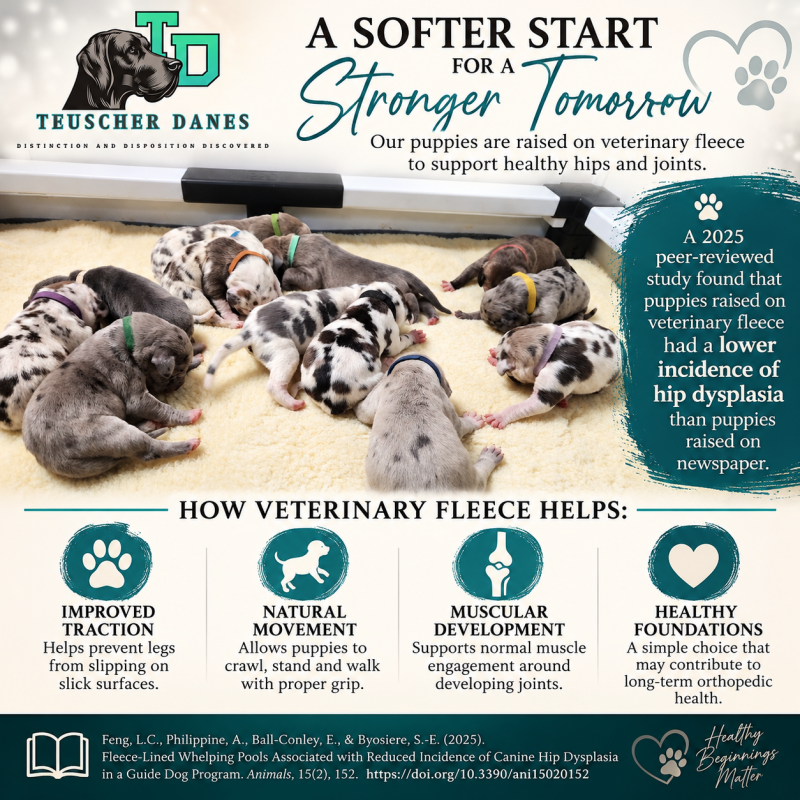
The surface on which newborn puppies develop may play an important role in their orthopedic health, particularly during the first weeks of life when their muscles, joints, and skeletal structures are rapidly developing.
Veterinary fleece, sometimes called Vetbed, provides a soft, textured surface that allows puppies to gain traction as they begin crawling, pushing themselves upright, standing, and eventually walking.
Research into canine hip development suggests that environmental factors during early puppyhood can influence the risk of developing canine hip dysplasia (CHD).
A surface that provides adequate traction may offer several developmental benefits:
Improved traction:
Helps prevent the legs from repeatedly sliding outward on slick flooring.
Natural movement:
Allows puppies to push against the surface while crawling and learning to stand.
Muscular development:
Supports normal movement and muscle engagement around developing joints.
Joint positioning:
May help reduce excessive slipping and abnormal limb positioning during early development.
Hip dysplasia is a multifactorial condition influenced by genetics, growth, nutrition, body condition, and environmental factors. Veterinary fleece is best described as one component of a supportive early-development environment rather than a proven preventive treatment.
The specific 2025 study on veterinary fleece
Fleece-Lined Whelping Pools Associated with Reduced Incidence of Canine Hip Dysplasia in a Guide Dog Program
Feng, L.C., Philippine, A., Ball-Conley, E., & Byosiere, S.-E. (2025). Animals, 15(2),